Decision Fork: Accommodation or Service?
Ever feel like reading an IEP is like deciphering a secret code?
Extended time.
Preferential seating.
Small group instruction
30 minutes
3x a week
At first glance, they all sound like simple classroom tweaks. But mixing them up can have serious consequences: from a student missing out on crucial support to a teacher taking on extra responsibilities unnecessarily.
One requires a dedicated specialist and scheduling, while the other is built directly into a teacher's day-to-day classroom learning environment. This blog post breaks down accommodations and services so you can feel more confident in your daily practice.
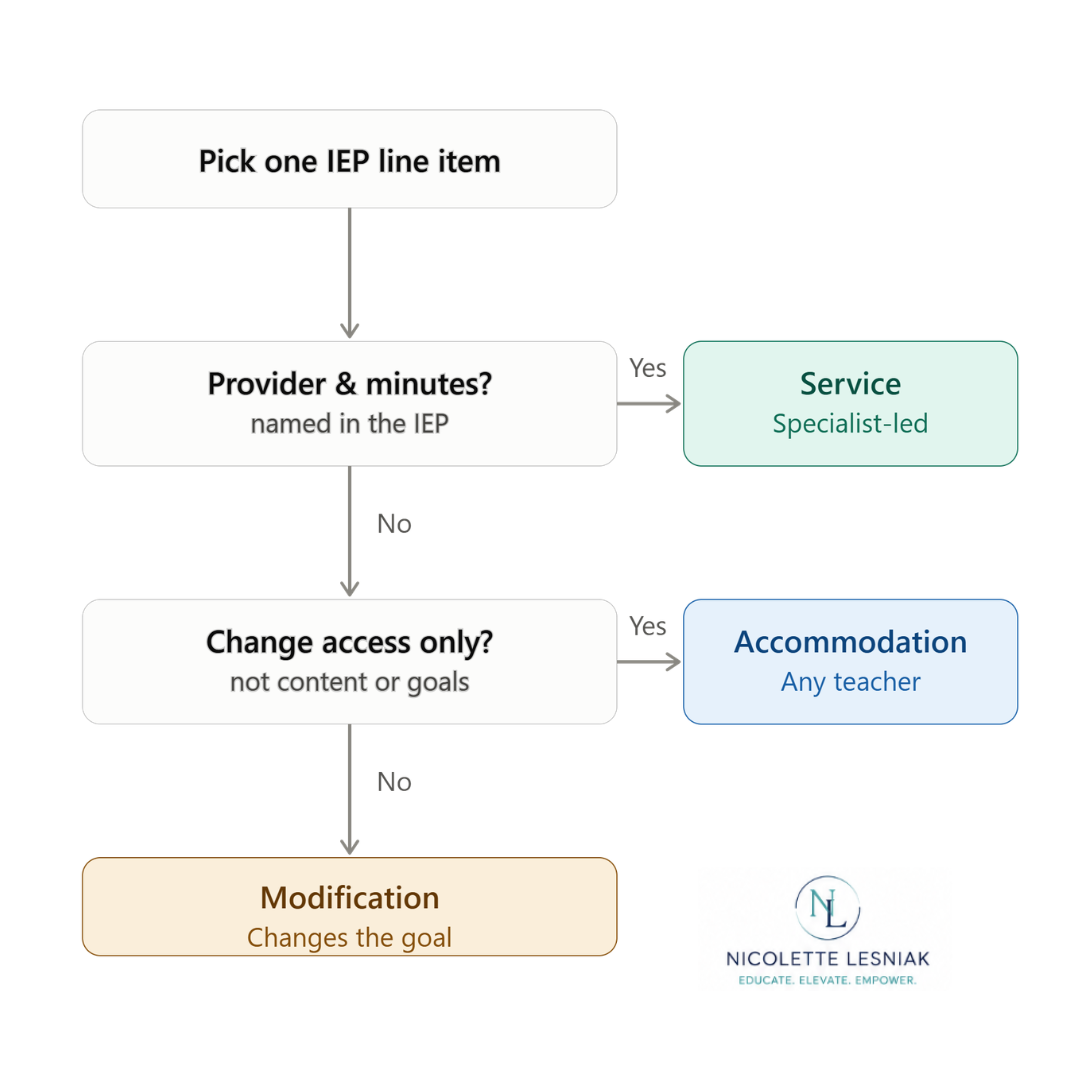
To quickly sort out any accommodation or service on an IEP, ask yourself these two simple questions.
Does it name a provider and schedule?
Does it change access, or does it change content?
Let’s Begin
Question 1: Does it name a provider and a schedule?
Look at the item in the IEP. Does it say who delivers it and how much: a specific person's role (speech-language pathologist, OT, special education teacher, paraprofessional) plus a frequency and duration (30 minutes, 2x/week; daily, 20 minutes)?
If yes, it's a service. Services are specially designed instruction or related services delivered by a qualified provider on a tracked schedule. They show up on the student’s IEP services page. The student has goals and/or objectives tied to it, and if those aren't met, that is a compliance issue. A general education teacher generally isn't the one delivering these; your job is usually to make sure the student gets pulled for services, or that a push-in provider has access to your classroom,
If no. No named provider, no minutes attached, then move to question 2.
Question 2: Does it change access, or does it change content?
Changes access only → accommodation. An accommodation changes how a student receives the same material and demonstrates the same knowledge, without changing what a student is expected to learn or how they are graded.
Extended time
A copy of notes
Preferential seating
Chunked directions
Reader for a test
Access to a calculator
Breaks during long tasks
These are all things you build into your regular instruction. No separate minutes, no pull-out, no specialist required. As the classroom teacher, you are qualified to provide the accommodation. The IEP is just telling you it's non-negotiable for the student.
Changes what's taught or expected → modification. If the item changes the actual content, the performance standard, or what the student is being graded on:
A shortened spelling list
Alternate grading criteria
Below-grade-level texts
Reduced number of problems that also reduces the skill being assessed — that's a modification, not an accommodation.
Modifications matter because they affect how you report progress and whether the student is working toward the same standards as peers. Mixing them up with accommodations can misrepresent what a student has actually mastered.
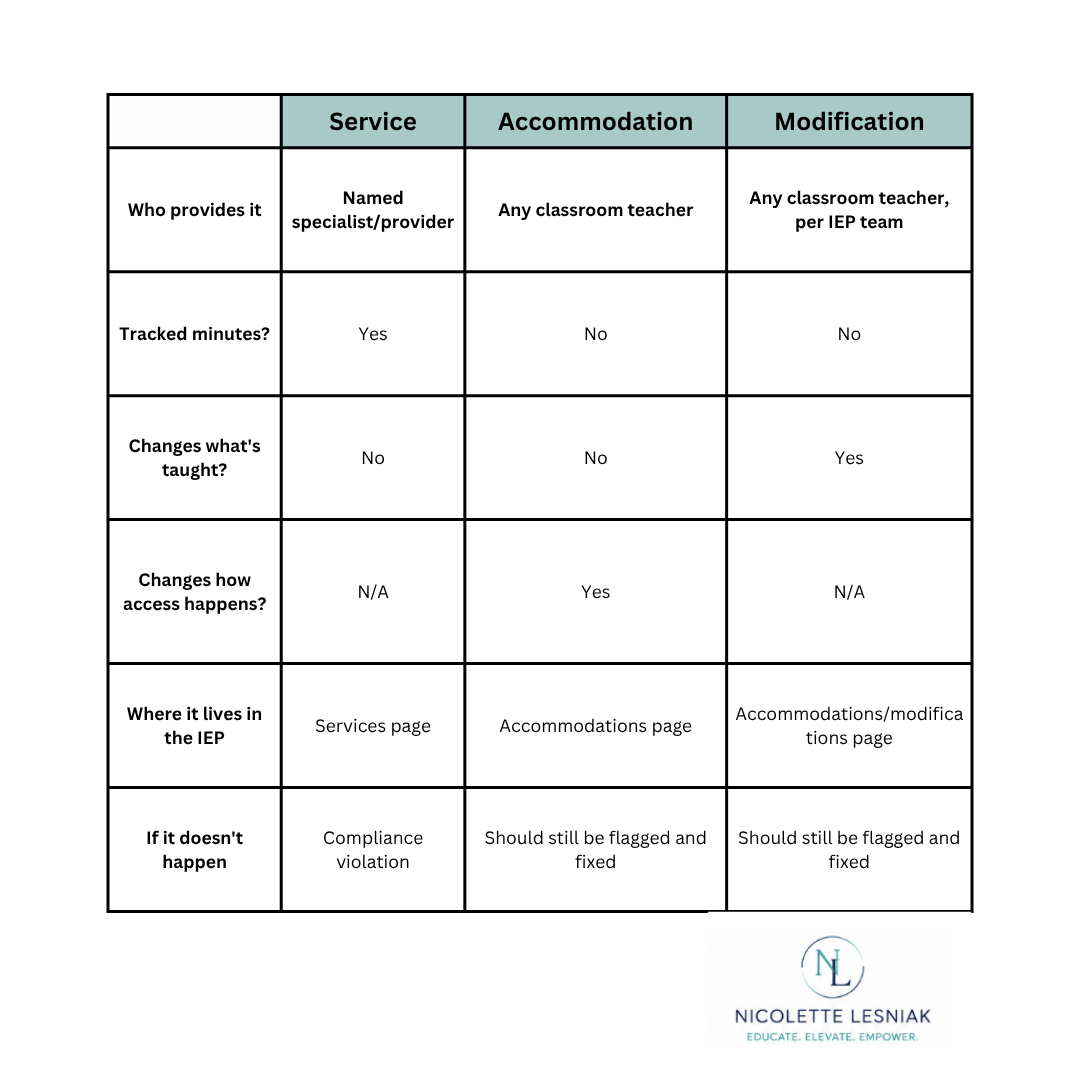
Where teachers actually get tripped up
"Preferential seating" sounds passive but isn't optional. It's an accommodation, which means it's still a requirement. Just one you are going to implement yourself without a specialist.
"Small group instruction" is ambiguous on its own. If it says "small group instruction for reading, 30 min, 4x a week, special education teacher", that's a service. If it just says "works best in small group settings" with no provider or minutes, an accommodation or a teaching observation note, and you will want to check with the student's case manager.
Read-alouds can be either. A read-aloud accommodation for tests (any adult can read the test) differs from a read-aloud service tied to a reading goal, delivered on a schedule by a reading specialist. Check for the provider and minutes.
Modified curriculum vs. modified presentation. Giving a student the same content in a different format (audio version of the textbook) is an accommodation. Giving a student less content or different content (5 vocabulary words instead of 15, with a lower mastery bar) is a modification.
When you are still not sure
If an item in an IEP doesn't clearly answer either question, no provider, no minutes, but also it is not obviously about access, discuss it with the case manager rather than guessing. Ambiguous IEP language is common, and it is the case manager's job to clarify intent, not yours to infer it.
Getting it wrong in either direction has real consequences: treating a service like an accommodation means a legally required service goes undelivered; treating an accommodation like a modification (or vice versa) can misrepresent what the student has actually learned.
Nicolette Lesniak, Ed.S, is a special education coach and advocate who supports teachers and teams in building collaborative, student-centered systems. If you are struggling to collect meaningful data that sparks change in your school or classroom, connect with her at nicolettelesniak.com.